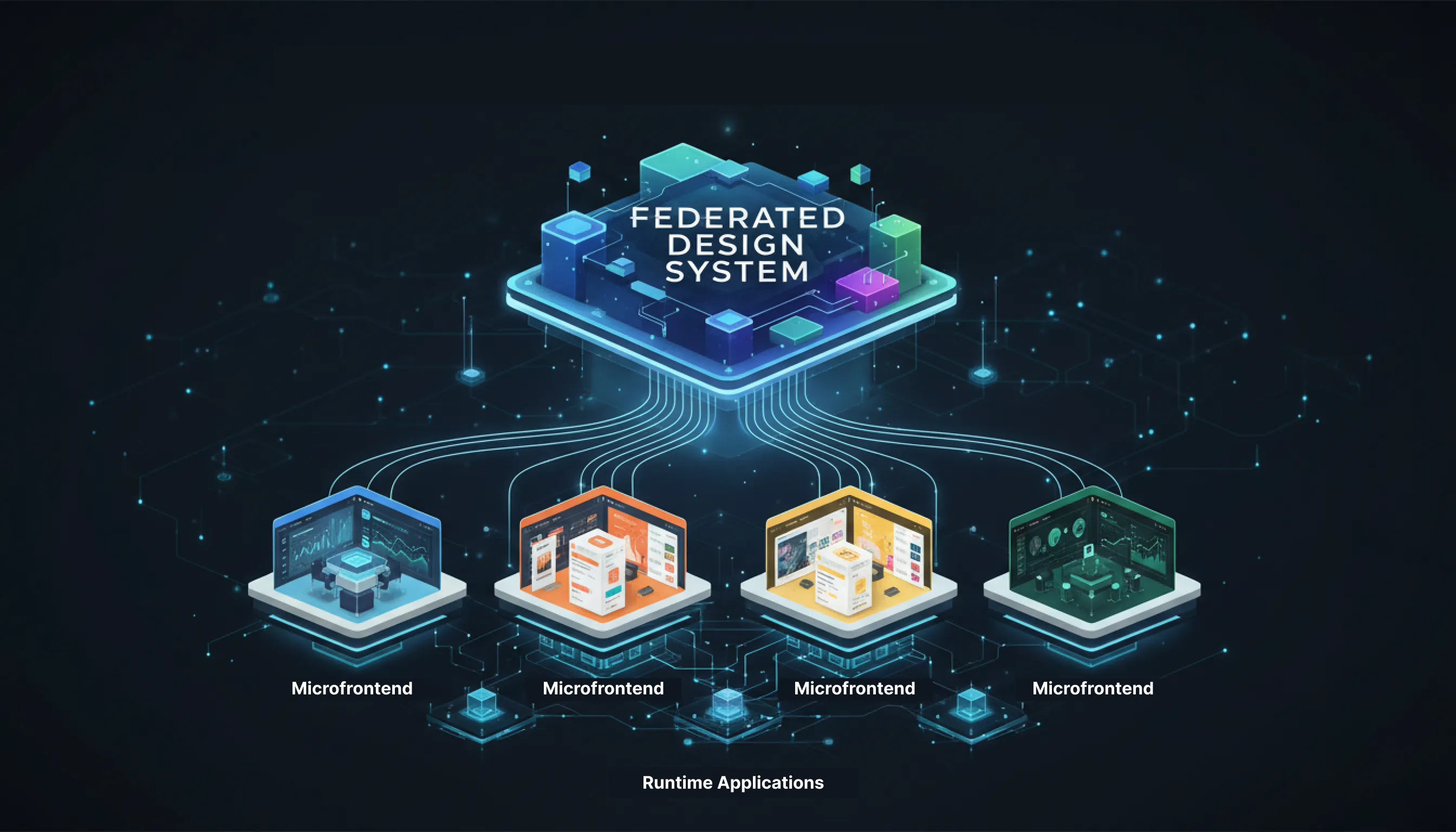
Introduction
Microfrontends (in the following mentioned as “MFEs”) promise autonomy but they can also quietly destroy visual consistency if not handled with care.
Before we start: In this article, the term token refers to a named design value from a design system, typically implemented as a CSS custom property (CSS variable). Please do not mix it with the lexical unit from the context of parsing.
If you’ve worked in a federated architecture, you’ve seen it:
- Inconsistent buttons
- Design token drift
- Duplicate theme injection
- CSS specificity battles
- Teams blocked by other teams’ releases
The root cause?
Most of the time, the Host owns the theme. That model doesn’t scale.
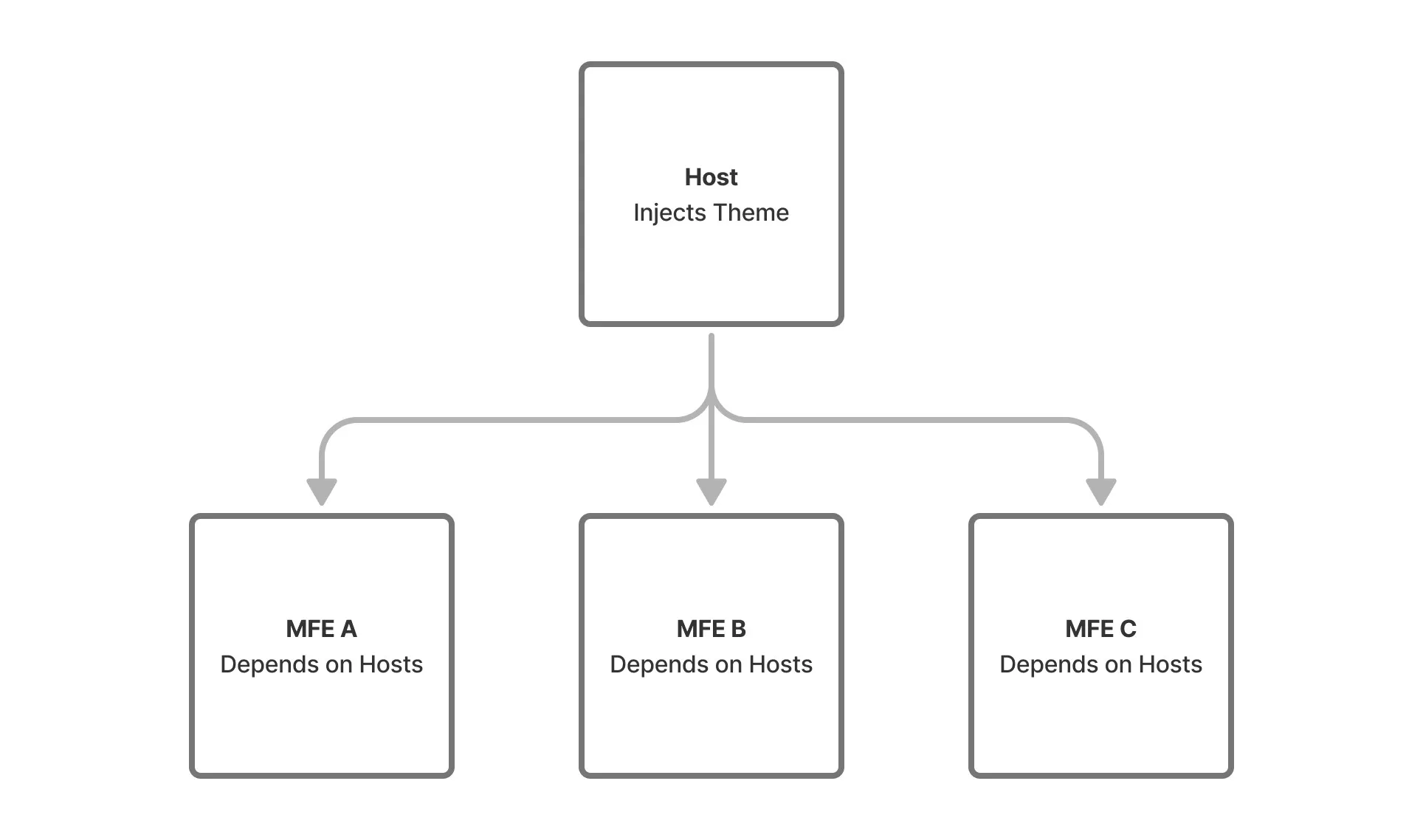
We can solve this by moving the source of truth out of the Host and into an independent Federated Design System (FDS). The result is simple but powerful:
A visual monolith that is operationally decentralized.
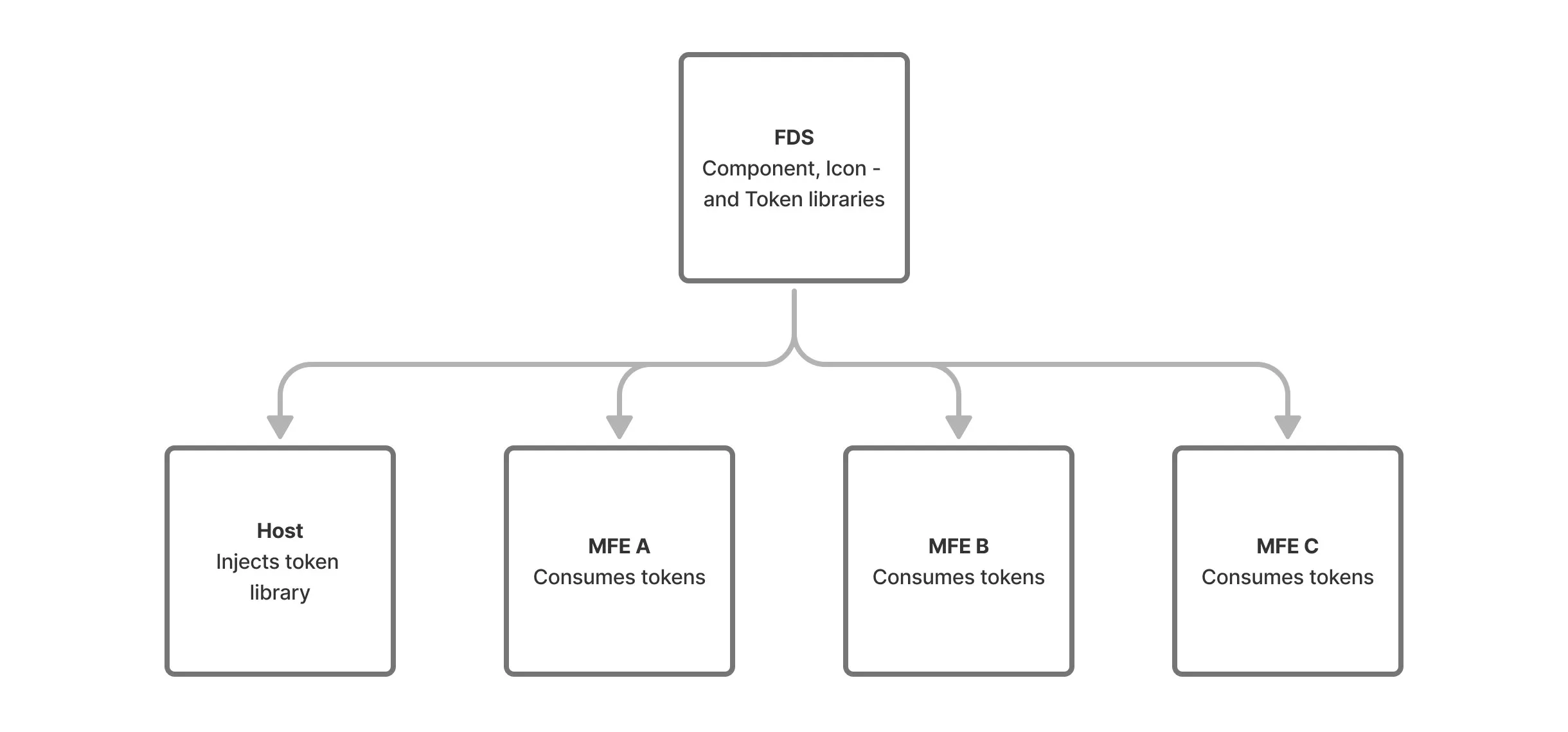 Here is the architecture — and why it works.
Design Tokens Are the Only Source of Truth
The foundation is brutally simple: a versioned npm package that contains only CSS variables and basic CSS declarations for font definitions, resets, and similar essentials. No components, no styling opinions — just design tokens and a minimal setup.
The Contract
- The Host injects the essential setup including the design token values
- The MFEs consume variable names from the active runtime
- Nobody hardcodes values
The MFEs don’t know brand colors at build time — and they shouldn’t. When the brand changes, the system updates at runtime. No rebuild. No redeploy. No drama.
If your micro-frontend needs a rebuild to pick up a color change, it’s not federated. It’s coupled.
The Singleton Theme Loader: Kill Multi-Injection
Micro-frontends share a runtime, which means they share the DOM. Without protection, every MFE injects its own copy of theme styles. That leads to:
- DOM bloat
- Overwritten variables
- Specificity wars
- Debugging nightmares
To mitigate this we can add a guard in-between. Create a small shared utility that every Host and MFE injects at the earliest possible point in time. If you use a StaticSiteGeneration (SSG) or ServerSideRendering (SSR) environment, define it on server side so deliver the theme with the initial HTML+CSS request. For CSR applications, define it at the entry file / root.
The utility has only one job — To check if the shared theme is loaded or not. If no theme is provided in the DOM, it is safe to inject the theme from MFE side.
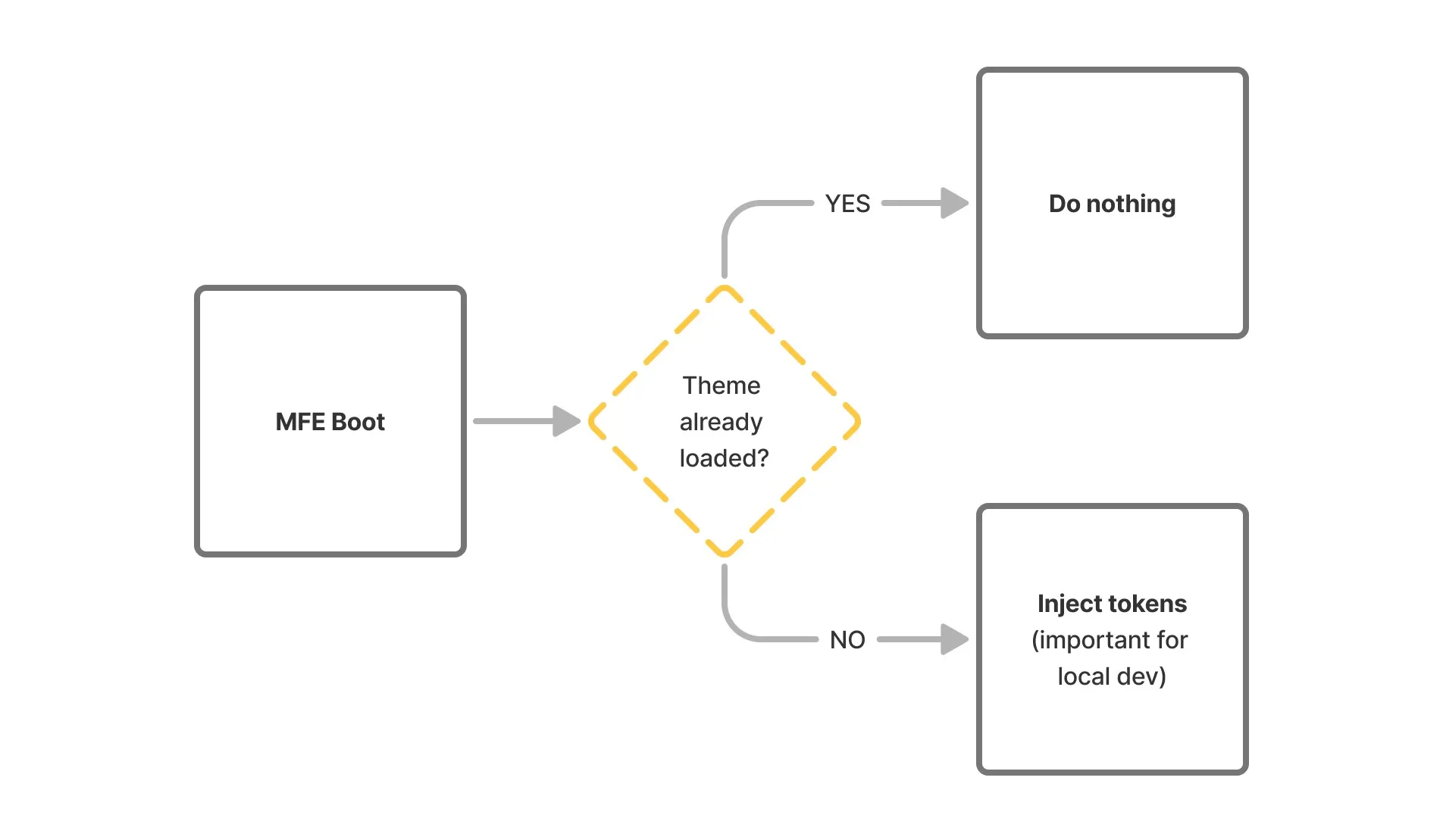
The implementation of such a Guard can be very trivial. See an example below:
// Runtime Guard example

declare global {
 interface Window {
  windowObjectKey?: boolean;
 }
}

const windowObjectKey = "__FEDERATED_THEME_LOADED__";

const loadGlobalStyles = (usePrimitiveComponentLibrary: boolean = true) => {
 // Check if "__FEDERATED_THEME_LOADED__" is already declared
 // If not, import the css definitions you need
 if (!(window as any)[windowObjectKey]) {
  import("@your-ds-lib/theme.min.css");
  if (usePrimitiveComponentLibrary) {
   import("@your-component-lib/index.css");
  }
  // Flip the switch to signal your import to the other MFEs
  // Next caller will face "__FEDERATED_THEME_LOADED__" to be defined,
  // therefore skipping the whole css loading
  (window as any)[windowObjectKey] = true;
 }
};

// Optional: If you want to easily check for the key to be set
const isGlobalStylesLoaded = () => {
 return (window as any)[windowObjectKey] === true;
};

export { loadGlobalStyles, isGlobalStylesLoaded };
The big benefit this creates is pretty clear. Only one design token instance lives in memory. As a result we have aligned and predictable global CSS behavior in a federated system.
Components Enforce UX Consistency
Design Tokens align colors and spacing. They do not enforce behavior. So we need to ship primitive brand components built on the design token layer:
- Button
- Input
- Modal
- Form controls
- All the other good stuff your Corporate Syleguide provides (hopefully via Storybook)
MFEs compose the primitives into composed components, meaningful UIs and domain features.
The payment confirmation button must feel identical to the save button in your user profile — Not similar. Identical. Autonomy should never mean visual entropy. You want the strictness to enable users to experience a consistent Customer Journey across all MFEs.
If every team builds its own Button, you don’t have a design system — you have a design suggestion.
Asset Sovereignty: Draw the Line
This is where most federated systems rot. If you don’t define ownership, everything becomes global — or worse, duplicated.
Brand Assets (Externalized)
- Logos
- Typography
- Illustrations
- Images
- Shared icon components
These should live in central asset services. (CDN for rasterized or vectorized imagery and an icon library providing icons as components). One source of truth. No duplication.
Application Assets (Local)
- Domain-only or Feature-specific components
- Reusable components scoped to MFE only
If it’s not reusable or relevant across the ecosystem, it doesn’t belong in the design system.
Federation requires boundaries. Keep them sharp and you can scale.
Namespace Discipline: Stop Style Bleed
Shared runtimes punish sloppy naming. We must enforce strict prefixing via localIdentName.
For global system wide desgin tokens:
/*
This is just an example.
Use -ds prefix to define that this part belongs to the design system
*/

localIdentName: "[local]--[hash:base64:5]-ds"
These global definitions should be owned by the central Design/Architecture team working on a meta-level above all application teams.
Application‑scoped design tokens
/*
This is just an example.
Use -mfe-<application-name> prefix to define that this part belongs to
a specific application. This also helps e2e tests and debugging later on
*/

localIdentName: "[local]--[hash:base64:5]-mfe-<application-name>"
These local definitions should be owned by individual MFE teams.
We have to be strict about this because common CSS definitions like the following WILL collide and result in style bleeding or the good old specificity war. And when they do, debugging becomes a real pain, I promise.
/*
Small example of definitions that will most certainly
collide between applications */
.main {}
.container {}
.layout {}
.card {}
Governance: The Social Contract
A federated system without proper governance will collapse sooner or later. When working with decentralized teams it is key to create clear and strict guardrails to keep the whole system scalable and maintainable.
The topic of system-wide governance and compliance rules is a major architectural subject that deserves its own article. For now, we will look at a small aspect focused on federated styling specifics.
Two non-negotiable rules:
No Magic Values in Host or MFEs
- No hex codes
- No random spacing
- No hardcoded pixels
- Everything maps to a design token.
If you bypass the system, you weaken it.
The (n - 1) Rule
Micro‑frontend teams deploy asynchronously. Your design system must respect that reality. If the Host system updates a shared library version n, all MFEs must support n - 1.
We can alias breaking changes during migrations to prevent specifications from failing:
:root {
/* New version */
--color-main: #0055ff;
/* Backward compatibility */
--color-primary: var(--color-main);
}
The backward compatible mapping is additional effort but it prevents us from:
- Cross‑team blocking
- Coordinated mega releases
- Fragile coupling
- Random style artifacts leading to bug tickets
Without this rule, your micro-frontends are fake independent.
Independent Execution (Yes, It Still Works Locally)
With the Singleton Theme Loader in place, MFEs can still run standalone without losing global theme context if not connected to a Host system. This is a small but crucial detail creating a higher degree on autonomy.injects
- Design tokens still resolve
- Global styling still works
- Local development remains frictionless.
Final Take: Decentralized Teams, Unified Experience
By following the above mentioned points we can ensure:
-
✅ Runtime‑safe theming
-
✅ Zero DOM duplication
-
✅ Predictable styling
-
✅ Independent team velocity (for style handling)
-
✅ Resilience to brand evolution
-
✅ System-wide consistent look and feel
The Federated Design System is not just a styling strategy — it is an organizational scaling mechanism that will help you stay productive in a federated architecture. Build it early. Enforce it strictly. Your future teams will thank you.
Happy coding 😎